
Those little yellow speed bumps along the road are the unsung heroes of temporary safety.
To be honest, people in our line of work all have a kind of “professional habit” when walking outside.
While others enjoy the scenery, I check if the traffic cones are neatly placed.
While others watch the cars, I examine whether the angle of the wide-angle mirror at the intersection is correct.
But recently, I’ve found myself unconsciously noticing some small things on the ground.
A while ago, I passed a municipal maintenance site where a trench had been dug for temporary cable laying.
The construction team neatly laid a row of yellow cable protectors across the trench.
Passing electric scooters, pedestrians, and even occasional small cars drove over them smoothly.
At that moment, I felt a strong sense of recognition.
This kind of product is something no one really notices in daily life.
But without it right here and now, cables would be damaged, maintenance would stop, pedestrians would trip, or traffic would jam completely.
It’s exactly the kind of item you never think about until you need it — and when you do, it must work reliably.
The cable protector category seems simple: it protects cables and keeps people and vehicles moving safely.
But if you pay close attention, you’ll realize there’s real skill and quality behind it.
I’ve seen events where organizers bought cheap, thin cable protectors that bent or even broke under pressure.
The result? Once a vehicle passed, the covers cracked, the cables inside were crushed, the sound system cut in and out, and the screens kept flickering.
It was extremely embarrassing.
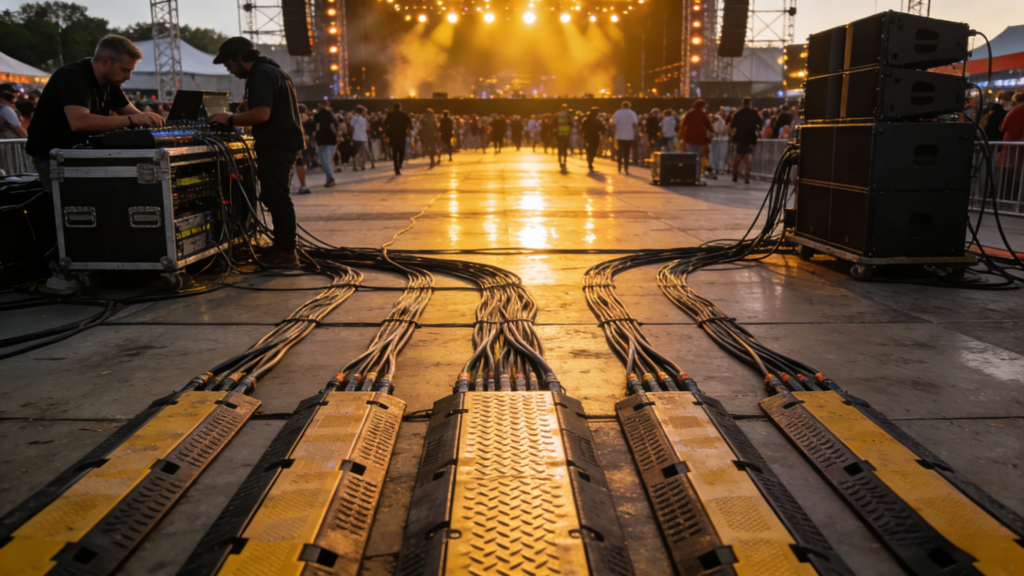
A truly high-quality cable protector is all about stability.
First, the material must be solid, with sufficient load-bearing capacity.
If heavy trucks occasionally drive over it, and the protector itself softens or bends under weight, nothing else matters.
Second is the design.
Is the internal space wide enough to hold multiple thick cables?
Do the top covers lock tightly without coming loose?
Are the anti-slip surface and warning color still visible in rainy weather or at night?
These details are what truly set premium products apart.
I chatted with an old friend who runs large-scale exhibitions not long ago.
He mentioned that his warehouse had replaced a batch of old cable protectors with new ones.
The reason was simple:
After long use, the old models no longer fitted properly at the joints.
The middle “bridge” often collapsed under pressure, and cables kept getting pinched or damaged.
The new ones, however, are not only thicker but also reinforced with ribs at every connection,
so they fit together perfectly and firmly.
“In our line of work, we have hundreds of people and dozens of devices on site,
and everything depends on these cables.
If the cable protectors fail, the whole event is ruined.”
His words are plain, but they make perfect sense.
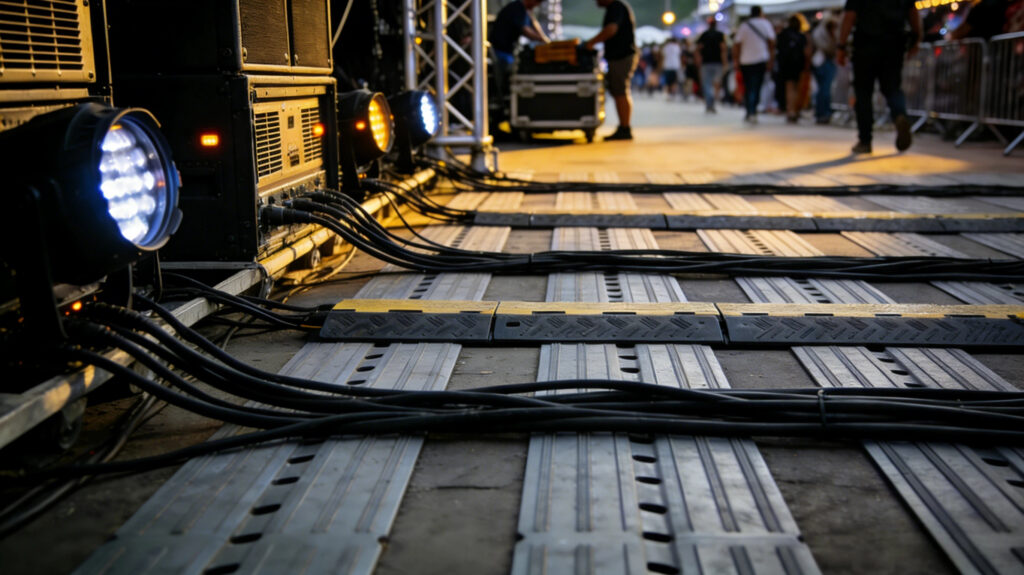
At the end of the day, cable protectors are not high-tech products.
Yet they reveal the true character of a construction project or event organizer:
whether safety is really taken seriously, and whether every detail is truly considered.
Sites that are messy, with cables lying exposed everywhere, are almost always missing these simple yet essential protectors.
But in well-organized sites, with smooth pedestrian and vehicle flow and neatly arranged cables,
you will almost certainly find a row of reliable cable protectors on the ground,
silently bearing all the pressure.
So next time you see those small yellow ramps by the road or at an event site, take a moment to notice them.
They are not roadblocks, nor are they traffic cones.
Yet, just like those safety devices, they provide the sense of security we all need on the road.